 EN
EN Classification Of Flood Walls
There are two main types of flood walls: reinforced concrete walls and masonry walls.
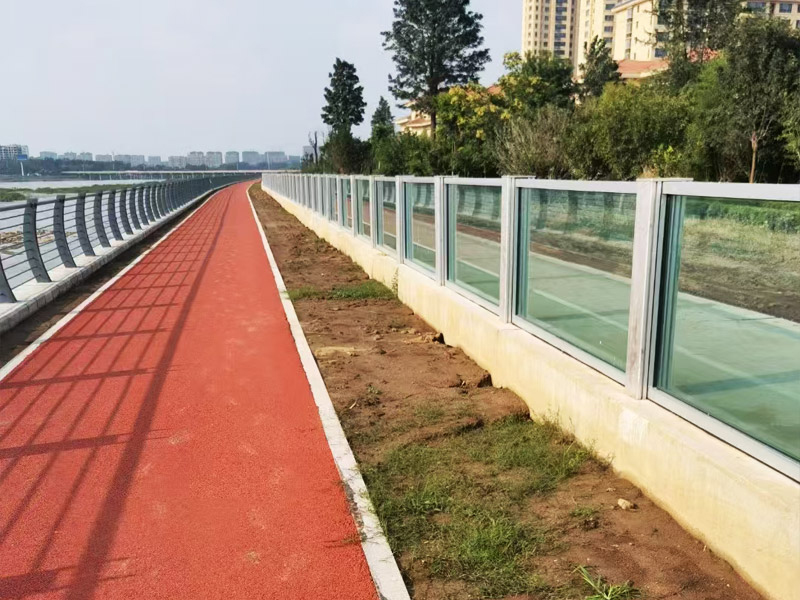
Reinforced concrete flood walls should be used in areas with weak foundations, small bearing capacity or limited ground conditions. According to experience, the underground burial depth is generally tens of centimeters to more than 1 meter. When the wall is higher, it is designed to determine the burial depth to prevent foundation deformation and affect safety. The width and thickness of the base are determined by the bearing capacity and stability strength calculation of the foundation. Make an anti-filter body or other forms of anti-filter at the backwater toe to reduce the seepage pressure. Sometimes, the back platform is built with soil on the backwater surface, which increases stability to a certain extent and is beneficial for temporary heightening and wave prevention. Some cities use the back soil of the flood wall for greening and beautification without affecting flood control safety, adding new scenery to the city.
In order to improve the foundation, piles can be driven under the flood wall to increase the stability of the foundation; in order to prevent seepage, the grooves on the water surface are often filled with clay or other anti-seepage bodies. Some cities use revetments or stone revetments to stabilize the embankment based on the river flow in front of the anti-seepage body. Shanghai, China, has more experience in this regard. In flood control walls and seawall projects, 60 kilometers of them have reinforced concrete arc-shaped anti-wave walls on the top of the wall, and some have arc-shaped protective walls to defend against wind and waves. Since the 1990s, some cities have adopted hollow box flood control walls, which are not only structurally strong, but also can further utilize the space inside the hollow box. For example, Wuhu City, Anhui Province, Liuzhou City, Guangxi Province, etc. have built hollow box multifunctional flood control walls.
Masonry flood control walls use the deadweight of masonry to achieve stability. They are generally divided into two types: one is made of concrete rectangular prefabricated parts; the other is made of stone mortar. Generally, the water-facing surface is vertical, and some are designed with steeper slopes, with a backwater slope of 1:1.